



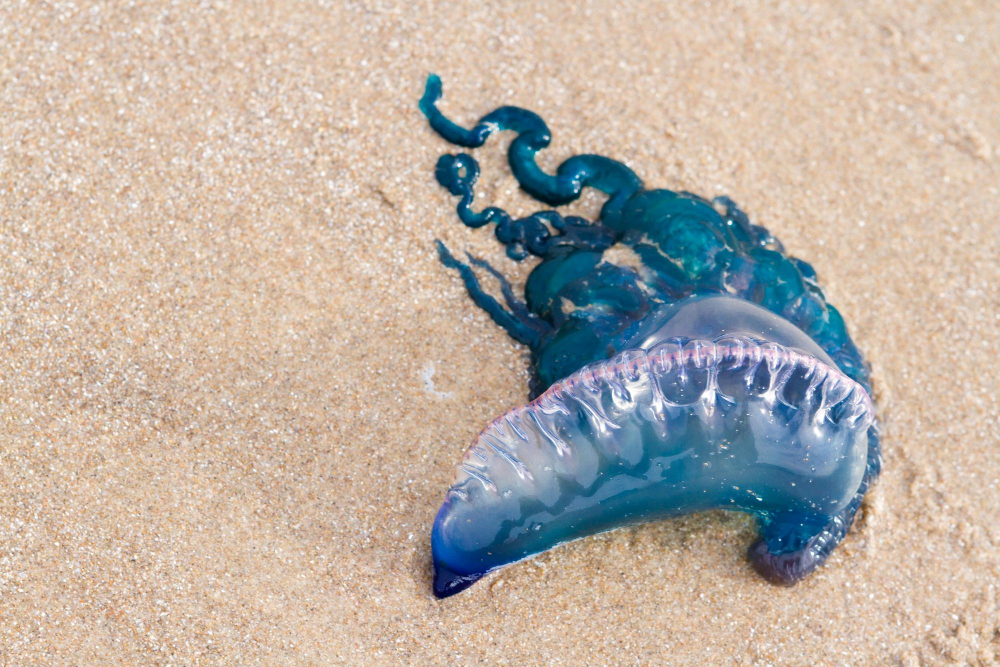
In the Mediterranean, the Portuguese Man O’ War (Physalia physalis) is still considered an "alien."
Indeed, it belongs to the species that arrived from the Atlantic through the Strait of Gibraltar. However, it is not a recent presence, as its still-partial distribution might suggest, but rather dates back over a century. Nor is it a jellyfish, as it is empirically considered, but a siphonophore, a colony of thousands of hydrozoans, called zooids, with well-defined and interconnected roles.
A common characteristic of syconophores is that they are colonial organisms composed of numerous invertebrate individuals, all of whom contribute, with their own specializations, to the life of the colony and could not survive without it. Aggregations give rise to organisms of extraordinary size, among the longest among marine inhabitants.
There is a part of the colony that justifies its name in several languages: the part that emerges from the surface of the sea and resembles, in shape, an ancient sailing ship, the caravel, sailing under full sail. Its scientific name is pneumatophore and consists of a transparent sac, with hues ranging from blue to mauve, between 15 and 30 centimeters in diameter, which floats thanks to the gas it contains. This mixture consists of carbon monoxide, nitrogen, oxygen, argon, and, in minimal quantities, carbon dioxide. The pneumatophore is equipped with an orifice that allows the gas to be expelled when the Man O’ War needs to submerge briefly to defend itself from attack.
The zooids that form the pneumatophore have a different role from the dactylozoids that, beneath the emerging "sail," make up the blue tentacles, which are remarkably long, reaching up to fifty meters. Ten tentacles are usually present, and they are the extremely powerful weapons used by the carnivorous man-of-war to capture the small fish, crustaceans, fish larvae, and plankton it feeds on. The tentacles are covered with nematocysts, the venom-filled stinging cells used by the man-of-war to paralyze its prey. These ten different types of venom are also identified by their different colors.
Encountering the tentacles of the Physalia is extremely dangerous, even for humans. Even the slightest contact can cause extremely painful and serious injuries, which in some cases can even lead to anaphylactic shock, cardiac and pulmonary complications, and even death. This marine animal should be avoided at all costs if you notice its presence. This also applies to encountering its tentacles or other beached parts, as the man-of-war remains venomous for some time after death.
Once the prey is paralyzed, specialized digestive polyps, the gastrozoids, come into play. They produce the necessary enzymes and transform the prey into nutrients that all the zoids will feed on.
Other specialized polyps, the gonozoids, are responsible for reproduction. Physalia is a unisexual organism, as all the zooids are of the same sex. When it's time to reproduce, the gonozoids detach from the aggregate to release eggs or sperm into the sea, depending on the sex of the colony they belong to. Fertilization occurs when male and female gametes meet in the sea, giving rise to new Physalia. However, existing colonies continue to grow through budding, multiplying the zooids, which will specialize in various roles useful in colonial life.
Fearsome even to humans with their venom, Physalia are preyed upon by various marine animals, starting with those that normally feed on jellyfish. In particular, Physalia are a staple of the diet of loggerhead sea turtles (Caretta caretta) and leatherback turtles (Dermochelys coriacea), as well as cetaceans, ocean sunfish (Mola mola), and some species of nudibranchs and mollusks.
Portuguese Man o’ War lives in warm ocean waters. However, a recent study by the Universities of Catania and Palermo and the Instituto de Ciencias Marinas de Andalucía, published in the scientific journal "Frontiers in Marine Science," has demonstrated, thanks to specimens held by the Natural History Museum of Florence and the Darwin-Dohrn Museum of the Anton Dohrn Zoological Station in Naples, that the Man O’ War has been present in the Mediterranean, depending on the area, since the second half of the 19th century or the early decades of the 20th century.
The progressive increase in temperatures in recent decades has led to more frequent sightings and reports. In this regard, given the animal's toxicity, anyone who sights the Physalia is encouraged to promptly report it to the competent Port Authority or local maritime authorities and to notify